She continuously brutalises herself being the masochistic being that she is. With her mental state, not even she knows the end. To dehumanize is the only way to be whole.
Thursday, August 18, 2011

Thursday, August 11, 2011
Tabula Rasa
I am scared. My gut is telling me that something is wrong. Perhaps it has been happening for quite a time now and I have talked about it in a few occasions. Yet this time around, it is getting the best of me. I tend to forget a lot. Petty as it may seem but it is a well-grounded fear for someone who values memories. I make them every day, from each time I wake up until I recall them at night. They are similar to the pages of a book, written with every vivid detail that can surpass all the fictional stories I have ever read. They have every character that played a role in my life, and I welcome them, good or bad. After all, nobody can make a good story without all the good elements. Yes, memories are the only ones I go back to whenever I have to make peace with myself; at times I want to comprehend the things I did and would do; and just so my present would no longer echo all the bad checks I cancelled and erased in the past. However, like all photographs, memories fade; like a fire, they dwindle down; and like all books, they fade. I do not want to wake up one day not knowing what happened. Blank.
Wednesday, August 03, 2011
LETRA. SULAT. WALA NA.
Mahirap magsulat lalo kung wala namang patutunguhan. Mas mahirap isipin kung ano ang magiging opinyon ng mga tao sa kung ano man ang mababasa nila. Maaari ko itong ikatuwa at maging daan para muli pa akong sumulat o kaya naman ay ilagay ko na lang lahat ng aking naiisip sa dulong bahagi ng utak ko at magbakasakaling maalala pa ito kinabukasan. Pero kung ang korte nga, isinasaalang-alang ang inevitable frailty of human memory (1), ako pa kayang taga-lupa? Hayaan na ang mga iisipin ng iba. Una, kailangang magsulat ng kagaya kong may mga bagay na hindi masabi, ayaw sabihin o walang pagkakataong makapagsabi dahil baka makalimutan ko na. Pangalawa, ang mga letra o salitang maisusulat ang magbibigay buhay sa mga kaisipang naapakan, naisiksik at nabura dahil sa panahong lumipas o dahil walang nakinig sa mga bagay na hindi ko sinabi. Huli, dahil kailangan ko ng dibersyon at libangan. Sa bilis ng agos ng buhay ko sa mga panahong ito, baka maiwan na naman yung mga alaala ko; lalong hindi ko na mabalikan.
Salamat na lamang sa isang guro at kaibigan na dati ay nagpawa sa amin ng blog na ito. Aksidente lamang na makita ko pa ito at kandahirap pa akong tandaan ang password. Mabuti na lamang pinaalala nito na una kong minahal ang pagsusulat at kahit gaano kawalang halaga ang aking mga pananaw bilang estudyante, may isang propesor na gusto pa rin itong malaman. Salamat, kailangan ng mga unibersidad ang mas marami pang kagaya mo.
Dahil tapos na akong mag-drama sa panimula, kelangan ko nang ilagay dito ang mga nakalkal ko sa lumang baul ng laptop. Huwag mo na silang basahin, maiinis ka lang.
2) Natutunan ko yata to dati sa unibersidad.
CONFESSIONS OF A DEPRESSED INDIVIDUAL
My life is a seemingly tiring process of getting tired. yup, true. it’s being here yet not wanting to be anywhere. The train i was into last night was quite spacious…unlike the previous ones i was in which the people did not seem to see how big I was and so they kept on pushing me until there was no pole for me to hold on to. Perhaps, those I used to be with in the train got tired of the routine and decided to take the jeepney or the cab instead. I hate the world today. Maybe it’s this depression that’s getting into me again. It’s like waking up only to realize that everybody goes on with his life except me. The same set of people I used to be with suddenly have another set of people they would want to be with. I’m not yet out of the picture, of course. but I feel like the space for a photo is just enough for two…and so, I have to give way. The set of clothes I always want to wear look so overused that I just want to keep them in my closet and lock them up. Even the music I’d die for just to listen to don’t have the same effect anymore; its lyrics sound just like the usual nursery rhymes my two year old niece keeps on playing. But then again, after writing this, I’ll realize that I still have piles of things to do and writing just gets the number of minutes for my law books. A tear will fall, sure. but i have to brush it aside and say, “hey world! is that all you can do?” and so, I will continue to smile that fake smile and shrug my little stiff shoulders like I always do. play that usual role I play in peoples’ lives and pretend that I am ok. after all, nobody will bother to hear the words i don’t say nor count the tears that will fall. At the end of the day, i only have my pillows to embrace and i’ll tell myself the following morning that, “i am trying to love you world, believe me when I say I am trying to.”
Some time between June - October 2007
LEARNING AND UNLEARNING
I’ve learned that its ok to eat alone, but the food doesn’t taste as good as it does when I have company.
I've learned that reading romance novels kills boredom, but I must not engage myself in a melodramatic experience assuming that I can be the heroine in my story. villain maybe? na-ah.
I've learned that it’s ok to feel safe in my world, but I have to be prepared for the unknown.
I’ve learned that music can heal, but it can also worsen the pain.
I've learned that six or seven hours of bus ride can make me agitated, but my level of agitation depends on who is waiting for me at the bus stop.
I’ve learned that a bored person like me can surf the net for the whole three hours, but it will not change a thing; I will still be bored after that.
I’ve learned that people can hate me, but oftentimes, it’s best not to mind them. Whose lungs may burst due to anger anyway? Definitely not mine.
I’ve learned that mirrors can show two faces, but beauty or horribleness depends on the side of the mirror that I choose to see.
I’ve learned that a girl can say the nastiest things when she’s in love and when she’s hurt, but how it affects me depend on how I want her to even be nastier.
I’ve learned that I can forgive, but the memories will always remain. echoing. haunting. piercing.
I’ve learned that it’s all right to put my phone beside me when i sleep, but I will no longer keep my windows open. it may be stolen again.
I’ve learned that it’s ok to check my phone when I wake up, but i must not get disappointed when nobody bothered to give me a ring last night.
I’ve learned that it’s ok to walk alone, but my hands feel cold and empty. I still hope that someone’s holding it.
I’ve learned that it’s ok to give everything, but I must not expect that everybody can see that it’s already everything.
I’ve learned that life always give me enough choices, but due to mere stupidity, i always choose the risky ones. I jump. I fall. I break.
I’ve learned that months, years or even decades cannot guarantee that the person i’m with will still be the same person i will be with when my eyes are closed, but I am always hoping and praying for that.
I’ve learned that numbness sometimes measures the pain, but it’s still best to shed tears and get over it.
I’ve learned that leaving someone can be the easiest or the hardest thing to do, but I always have to ask myself if it will make me happier in the end.
I've learned that rings are not lifetime guarantees, but i can always hold on to them for assurance. If they can serve as guarantees, then thanks a lot. If they don’t, i can always buy myself one at the nearest jewelry store.
I’ve learned that one can give me the warmest hugs, but i always prepare my pillows. just in case nobody’s there.
But at the end of the day, I sometimes learn that it’s as if i did not learn anything at all.
November 7th, 2007 at 11:07 pm
ISANG PAMAMAALAM
Sa loob ng ilang linggo, lilisanin ko na ang Baguio…isang lugar na naging tirahan at nag-aruga sa akin sa loob ng apat na taon…sa gagawin kong pagbaba, marami akong makukuha pero marami ring magiging kapalit…
Wala ng Kaffee Klatsch na kung saan maaari kaming mag-jam ng mga kaibigan ko…wala ng Starmart Engineer’s Hill na may bente pesos na kape…wala ng taxi na puwede akong iikot sa baguio at benguet sa halagang p150…wala ng sm baguio na puwede kong puntahan kahit naka-pyjamas ako…wala ng burnham park na bibilhan ko ng fishballs at squid balls…wala na akong bibisitahing mines view dahil sa kanilang inihaw na pusit at hotdog on stick…wala ng session road na inaakyat-baba ko lang…wala ng manang siomai na binibilhan ko ng tatlong piraso ng super sarap na siomai sa halagang sampung piso…mawawala na rin ako sa loob ng unibersidad ng pilipinas baguio na kung saan maaari akong tumambay sa lobby ng nakasalampak…wala na rin akong pupuntahang tambayan katulad ng im plaza stairs…wala na yung lamig na nagiging dahilan ng tuwirang pagpapa-laundry ng makakapal ng kumot at comforter…
Pagdating ko dun, papasukin pa kaya ako ng guard kahit nakasuot ako ng rubber flip-flops? magkakaroon pa kaya ng silbi ang makakapal kong jacket at sweat shirts? makalabas pa kaya ako ng bahay na nakasuot lang ng jogging pants at baby tee habang ang laman lang ng wallet ko ay isang daan? kailangan ko na rin bang magsuot ng mini skirt at backless tops? makapagtext o makatawag pa kaya ako habang papasok ng campus na hindi nangangambang ano mang oras ay may hahablot sa telepono ko? masabayan ko kaya ang hangos ng mga taong nagmamadaling papasok ng lrt o mahabol ko kaya ang bus na nagmamadali sa pag-pick up ng pasahero?
Ang daming magiging pagbabago…hindi ko alam kung ikatutuwa o ikatatakot ko… dito ang bagal ng takbo ng oras at ang bawat minuto ay lumilipas na nararamdaman ko ang buhay…ang cheesy na ng sinusulat ko…pero siguro, ang gusto ko lang sabihin, tumatak na sa akin ang baguio at ang mga taong nakasama ko..dito natuto akong bumuo ng pangarap…salamat sa mga taong sinamahan akong buuin yon…parte na kayo ng alaala ko…
March 27th, 2007 at 1:12 am
Monday, September 11, 2006
Remembering 9/11
 The majestic World Tade Center towers over Manhattan...
 Flight 175 hits the tower...
 President George Bush condemns the terrorist attack infront of other world leaders
Osama Bin Laden gives statement on the attack
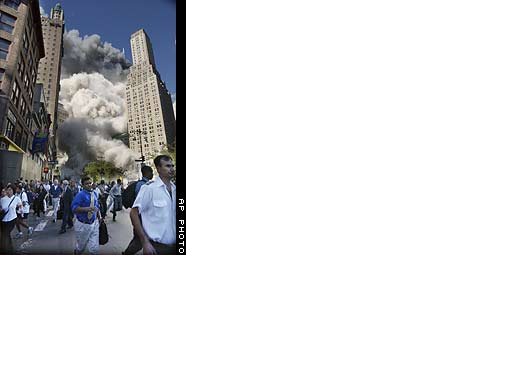 People run for their lives as the world trade center crumbled
 The debris of what once was majestic...
 A woman holds a picture of the world trade center as people gathered to remember the terror that shook 9/11
 Wednesday, August 30, 2006
Blogging is Journalism.


Blogging is journalism. I would have said otherwise and I would not have agreed had I not heard Professor Rolando “Rolly” Fernandez, Philippine Daily Inquirer Northern Luzon’s Bureau Chief, discuss the issue. He considered blogging as journalism and he also posted a question that has been a source of debate in our class: “Who and what is a journalist anyway?”
We had a class discussion on blogs as an emerging form of journalism. Well, I thought otherwise. There were some points raised that in able for a blog to be considered as journalism, the writer who owns it should at least belong to a news organization [just like he has to be part of one for him to be considered as a journalist]. The topics or the content of the said blog should also be “journalistic” in nature in a such way that it has to have social relevance. Same sentiments that I had. I also thought that there really should be a thin line that separates the writers or the bloggers from the real journalists.
But after the talk, I could not help but consider it as one. After all, Sir Rolly said that it can also be a source of information for journalists. Yes, perhaps it is indeed journalism. Its advent did not only pave the way for online discussions but also, it made tasks easier for journalists and other people who wish to convey their ideas and opinions regarding matters of public interest. Bloggers can just go online and talk about issues that people need to know. He also gave an example about a journalist who posted her work in the internet and got more feedback online, than feedbacks on her column printed in a newspaper. Somehow, it also gave way for interaction between a journalist and his readers to clarify some issues of the article written. However, blogging should also be concerned with legal issues as pointed out by our speaker [Sir Rolly]. It should not be all about writing whatever one wants. And yes, I could not have agreed more. A blogger should always be responsible for the things he writes because he will never know how it would affect his readers.
We had a class discussion on blogs as an emerging form of journalism. Well, I thought otherwise. There were some points raised that in able for a blog to be considered as journalism, the writer who owns it should at least belong to a news organization [just like he has to be part of one for him to be considered as a journalist]. The topics or the content of the said blog should also be “journalistic” in nature in a such way that it has to have social relevance. Same sentiments that I had. I also thought that there really should be a thin line that separates the writers or the bloggers from the real journalists.
But after the talk, I could not help but consider it as one. After all, Sir Rolly said that it can also be a source of information for journalists. Yes, perhaps it is indeed journalism. Its advent did not only pave the way for online discussions but also, it made tasks easier for journalists and other people who wish to convey their ideas and opinions regarding matters of public interest. Bloggers can just go online and talk about issues that people need to know. He also gave an example about a journalist who posted her work in the internet and got more feedback online, than feedbacks on her column printed in a newspaper. Somehow, it also gave way for interaction between a journalist and his readers to clarify some issues of the article written. However, blogging should also be concerned with legal issues as pointed out by our speaker [Sir Rolly]. It should not be all about writing whatever one wants. And yes, I could not have agreed more. A blogger should always be responsible for the things he writes because he will never know how it would affect his readers.
Monday, August 28, 2006
Kara David's "Buto't Balat"
I thought it would just be another boring weekend for me, waiting for the clock to move its hands for another hour or so. But then, I remembered that I-witness, a documentary program of GMA 7 would be showcasing some of its documentaries in school. Being a documentary addict, plus the bonus of meeting some of GMA’s famous journalists, I, together with my friends, decided to go and watch.
First to be shown was Kara David’s “Buto’t Balat”, a documentary on severe malnutrition in the Philippines. Perhaps almost everyone on the audience was affected by the things and the facts presented in the documentary. There was a case of a girl who was bed ridden because of malnutrition and when asked of the reason why she became that way, her mother said they only eat once or twice a day. The family could not provide enough food for themselves, which resulted to the girl and her other two siblings’ death. Also featured was a family of nine which would eat three times a day but with improper food intake. The weight of the oldest child, 14, would only pass for the weight of a two-year-old. And when data were shown, the Philippines ranked 2nd in cases of severe malnourishment.
I have only watched two of the four documentaries yet I knew that it was enough. I was greatly affected with what I have seen that I couldn’t help but wonder what the world’s richest tycoons are doing with their wealth when millions of people are dying of hunger. It is indeed ironic how the “rich are getting richer and the poor are getting poorer”. Buto’t Balat also showed what the Philippine government has somehow been denying by building more super highways and infrastructures: poverty. This documentary stood up to its duty of showing the reality behind the entire façade of the government’s claims of serving the people. In a world where the price of perfumes cost almost a month’s salary, there are also people who could not even afford a day’s meal.
Links to sites that contain information on malnutrition:
First to be shown was Kara David’s “Buto’t Balat”, a documentary on severe malnutrition in the Philippines. Perhaps almost everyone on the audience was affected by the things and the facts presented in the documentary. There was a case of a girl who was bed ridden because of malnutrition and when asked of the reason why she became that way, her mother said they only eat once or twice a day. The family could not provide enough food for themselves, which resulted to the girl and her other two siblings’ death. Also featured was a family of nine which would eat three times a day but with improper food intake. The weight of the oldest child, 14, would only pass for the weight of a two-year-old. And when data were shown, the Philippines ranked 2nd in cases of severe malnourishment.
I have only watched two of the four documentaries yet I knew that it was enough. I was greatly affected with what I have seen that I couldn’t help but wonder what the world’s richest tycoons are doing with their wealth when millions of people are dying of hunger. It is indeed ironic how the “rich are getting richer and the poor are getting poorer”. Buto’t Balat also showed what the Philippine government has somehow been denying by building more super highways and infrastructures: poverty. This documentary stood up to its duty of showing the reality behind the entire façade of the government’s claims of serving the people. In a world where the price of perfumes cost almost a month’s salary, there are also people who could not even afford a day’s meal.
Links to sites that contain information on malnutrition:
UP it is...
“If you work for a man in heaven’s name, work for him, speak well of him and stand by the institution that he represents…”
- Elbert Hubbard
Perhaps, Secretary of Justice Raul Gonzalez was thinking of this line in defense of Arroyo’s administration when he dropped the words, “That school that builds destabilizers every year…” pertaining to the University of the Philippines and its students. Yes, it is just but right to defend the institution [government] that he works for but not to the extent of questioning the kind of students that UP breeds and even the culture that every UPan grows up into. Why question the culture when it should not even be in question. Yes, there may be men and women running naked. So what? It is an expression of what they believe in and it is what makes UP different from the others, even from your [Gonzalez's] school. UPans are unconventional, accept that fact.
I once told myself that it is undeniably an irony how the government subsidizes its budget for UP and yet, the same students that it supports are the same people who go against it. The cliché “biting the hands that feed you” can simply be applied to the situation. But being thankful of the budget given by the state should not be equated with being silent of the mistakes and offenses it commits. Perhaps, that was what our dear Secretary forgot.
Being an Iskolar ng Bayan entails a lot of responsibility. It is not all about the prestige [like what other people think] that goes with the name but also, the duty to give something back to the people. And that includes checking the excesses of the government, even if, as Gonzalez put it, “the state is the one paying” for our schooling and so, “why try to bring it down”. Yes, there should be some gratitude that is why UPans rally and shout in the streets to let the people know that there is something wrong.
As a UPan, I firmly believe that I owe my gratitude to the people and not to the government. In the first place, if Gonzalez can assure that the Philippines is indeed in good governance then, perhaps, everyone would just sit back and relax just like “well-behaved” individuals. But then, he seems to be blinded only by the good things that “his” government does. He refuses to see beyond.
Poverty. Corruption. Political Killings. The things that every UPan loathes of.
Secretary Gonzalez, unlike you, UPans are not blind of the felony of the government; they are not deaf to hear the muffled cries of those who died for their beliefs and they are not mute to scream what they believe in. They are bright and good, you yourself, said so.
Wednesday, July 26, 2006
Her Excellency's State of the Nation Address (Part1)
It was the most awaited speech in the country every year. The two giant networks and almost every television station covered the event. Even before the clock strikes at 12nn, correspondents from different stations were already at the Batasang Pambansa to wait for the highest officer of the country. Finally, on the 24th of July, at past 4pm, her Excellency Gloria Macapagal-Arroyo gave her State of the Nation Address (SONA).
She opened her speech by first congratulating the new Senate Leader Manuel Villar and acknowledging Minority Leader Jose De Venecia. Then, she updated the nation on the government’s effort of being able to send over 200 OFWs home. After which, she added that this time, she was not there to talk about politics. Or that’s what the people thought. The president’s one hour and one minute SONA mainly addressed the administration’s plan for the four super regions: Northern Luzon, Metro Luzon Urban Beltway, Central Luzon and Mindanao. She recognized each super region’s potential in boosting the economic condition of the country. Apart from this, she gave proposals on developing infrastructures to connect and to improve transportation on certain places in the said regions. She even challenged, Tony Boy Locsin, who once said that such plans were not possible. Her SONA was as specific as reducing the cost of electricity, extracting Gethropa for an alternative fuel, and “stamping out terrorism and lawless violence”.
Everything the president presented was impressive and her plans were very detailed. The videos and the PowerPoint Presentation added in giving the people a clearer view on what she wanted to convey. Critics said that it was the most high-tech SONA she had given. But as expected, in the duration of her speech, she never failed to acknowledge the presence of those who supported her administration: from the AFP, the congressmen, to the former president Fidel V. Ramos. And the company Bb. Pilipinas Universe and Pinoy athletes like Manny Pacquiao, seemed to give GMA that “I am a successful president” aura. And again, as expected, applauses and cheers followed every end of her statement.
Her Excellency's State of the Nation Address (Part2)
Promises, promises and more promises. In her SONA, she appeared like the typical politician [and not a public servant] that she really is. Fine, her plans were good and admittedly, she has made some accomplishments. However, she seemed to have failed to mention the source of the budget of her proposed projects. Yes, the country has the money, or so the administration claims. But since, it was not clearly explained, it posted the question if Filipinos of today and the next generation, will still continue to pay the debts that the country acquired and will still acquire from other countries.
If it was a State of the Nation Address, why did she ever forget to mention the real state of the nation? There are unemployment, corruption and poverty in the country. She said that she condemns political killings, but up to now, only a few are solved or perhaps, they were unsolved at all. The clamor of the people in Commonwealth Avenue proved the discontentment in her administration. Also, in between her address, she accidentally pushed her political stand on the Constitutional Change. While it is true that there is no such thing as a perfect president, one could at least do so by being a good example. But how can people trust in one whose legitimacy of winning the election is still being questioned?
I once heard from one of my instructors that the Philippines is changing not the form and system of its government but only people who all have the same purpose and motives to be in the government. Therefore, the cycle of having a rotten political system continues. And so, if the president wasn’t politicking, then I no longer know what to call her SONA.
Subscribe to:
Posts (Atom)